Data model
BlockDB offers three logical table types: regular tables, and the business abstraction layer’s Block State Table, Block Event Table, and Time Table. Each targets a different data shape and serves different business scenarios.The three logical table types
Regular tables (Table)
A regular table maps 1:1 to a physical online table. Use it for non-on-chain business data, or for high-value data derived from on-chain processing. It provides row-level, semantic read, write, and scan APIs.Block State Table
Purpose: maintain the latest state of on-chain entities, plus their state at any historical height. Whenever data for a new height arrives, BlockDB stores a historical snapshot at that height and asynchronously updates the latest-state table. Example scenarios:- Token balances for user addresses.
- Current state variables of a smart contract.
- Current owner of an NFT.
0xabc... at block height 18000000” — a Block State Table can return the state at any historical height, anchored on a block.
Block Event Table
Purpose: maintain every event that happened on chain, for exampletoken_transfer transfer events. Once an event happens at a given height it is unique and immutable — append-only, never updated.
Example scenarios:
- Token transfer logs (token_transfer).
- Events emitted by contracts.
- Individual matched trades on an exchange.
transfer events to compute from / to / value for every transfer in real time.
Time Table
Purpose: maintain a state series that changes with real-world (wall-clock) time, for example a token’s USD price table. Example scenarios:- A token’s USD price every minute.
- TVL snapshots per minute.
- Any metric that changes with physical time.
For the models and on-chain semantics of Block State and Block Event tables, see Block State Table and Block Event Table; for Time Table, see Time Table.
The shadow table mechanism
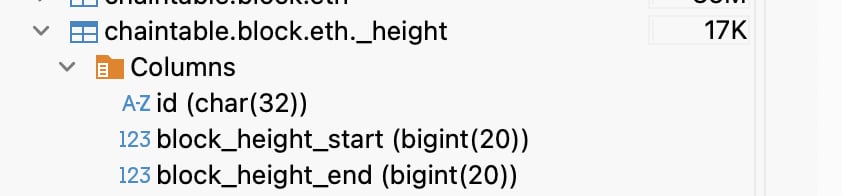
A business abstraction table does not map directly to a single physical table. When you create one, BlockDB automatically creates several cooperating regular tables (shadow tables) in the storage layer, each maintaining a different dimension of the data:Sub-table names use an underscore prefix:
<abstraction_name>._archive / _height / _bundle._heighttable: records closedheight_start/height_endintervals, marking which height ranges have been processed contiguously; also used to determine the consensus height. Useful for troubleshooting gaps; you rarely touch it in code._archivetable: stores historical snapshots. Same structure as the source table, except theidcolumn becomesoriginal_idand a newidcolumn is added._bundletable: maintains a data hash per 1000 blocks, mainly for offline systems such as S3 sync.
GetRow / BatchGetRows / FilterRows), which is handy for troubleshooting or expert-mode reads. However, writing to shadow tables through the regular-table write APIs is forbidden — all writes must go through the business abstraction table’s own block or time semantic write interfaces.
Block State shadow tables

Block Event shadow tables

The _height progress table